European rail transport is facing one of its most significant technological shifts in more than two decades. GSM-R, the communication system that has formed the backbone of railway operations since the mid-1990s, is approaching the end of its life cycle. The system is based on 2G technology, the same generation as the first digital mobile phones, and this technology is now being phased out globally.
As suppliers discontinue equipment and spare parts, communication between trains and traffic control risks becoming vulnerable. A new system therefore needs to take over.
The new solution is called FRMCS, Future Railway Mobile Communication System. It is based on 5G technology and will play the same role in the railways of the future as GSM-R has played until now: carrying the communication that enables trains to operate safely, efficiently and in a coordinated manner.
To better understand what this transition entails, we spoke to Pipsa Hallner, Strategic Development Manager at the Swedish Transport Administration and one of Sweden’s representatives in the European FRMCS work.
Why GSM-R and 2G are no longer sufficient
GSM-R is not a system most passengers ever think about. It is neither visible nor audible, and it is not connected to onboard Wi-Fi. Yet without GSM-R, the railway comes to a standstill.
The system is used for:
- train radio communication between drivers and traffic control
- emergency calls that are prioritised over all other traffic
- communication for ERTMS/ETCS, the European train control system
- positioning data, authorisations and signalling messages
All of this is transmitted over a voice-centric 2G system with very limited data capacity. As the requirements for modern train operation increase, for example through:
- ATO (Automatic Train Operation)
- more detailed real-time data from trains
- diagnostics, video and sensors
- energy-efficient driving
- higher levels of automation
…2G technology is no longer sufficient.
“From a technical perspective, there are several generations between GSM-R and FRMCS. We need a system that can realise both today’s and tomorrow’s requirements – and GSM-R cannot do that,” says Pipsa Hallner.
Why FRMCS is needed – and what it changes
FRMCS is the system that will take over as GSM-R is phased out. But it is not an “upgrade” in the traditional sense. It is a new mobile communication system designed to realise and further develop the operational functions of the railway for decades to come.
GSM-R was designed at a time when voice communication was the primary function. FRMCS, by contrast, is based on an architecture where both data and voice communication are equally important. This allows the system to support today’s needs as well as future solutions, such as advanced automation, detailed diagnostics and real-time control.
What distinguishes FRMCS from previous generations is its modular, service-based architecture. Instead of a monolithic system, FRMCS consists of multiple interacting functions with open interfaces. This allows parts of the system to be developed, replaced or improved without disrupting the whole, a prerequisite for long service life and continuous evolution.
FRMCS is therefore not only about capacity. It is about quality, robustness and long-term sustainability.
“We are moving from a system that was fundamentally built for voice communication with added data capabilities, to a system where we need to handle extensive voice and data communication in complex, interacting environments. That requires a completely different technical platform,” says Pipsa Hallner.
How a European system is created: from requirements to standards
Work on FRMCS began long before GSM-R reached the end of its life cycle. As early as 2013, the International Union of Railways (UIC) started defining which functions would replace GSM-R and which new requirements future systems would need to meet. This work progressed in several steps: user requirements, followed by functional requirements, and finally system requirements.
In parallel with these three layers, ETSI translates the requirements into technical specifications and standards – detailed documents describing what must be implemented so that suppliers can develop equipment that behaves consistently across all European countries.
ETSI standardises FRMCS under Standardisation Request M/603 (C(2024)2466):
Commission Implementing Decision of 22 April 2024 on a standardisation request to the European Telecommunications Standards Institute regarding the definition of system specification requirements for the Future Railway Mobile Communication System, in support of Directive (EU) 2016/797.
What Phase 1 and Phase 2 actually mean
FRMCS standards are often described as being developed in two phases. But what does this mean in practice?
Phase 1 – the first technical whole
Phase 1 provides the first complete version of the FRMCS specifications. They are sufficiently detailed to allow:
- suppliers to begin developing equipment
- test environments to be established
- system interfaces to be analysed
- pilot installations to be planned.
However, Phase 1 is not a finished system. Its purpose is to establish a common baseline for experimentation and verification. It is at this stage that shortcomings, ambiguities and the need for reformulation are expected to be identified.
Phase 2 – the version intended for real-world deployment
Phase 2 consolidates results from:
- national test tracks
- supplier-led testing
- Europe’s Rail Joint Undertaking
- system validation within MORANE 2
- cooperation between ETSI and UIC
- feedback from infrastructure managers, operators and the telecom industry
When Phase 2 is published, the standards are expected to be sufficiently aligned to be referenced in the TSD for Traffic Management and Signalling, the EU’s binding technical regulatory framework governing how signalling and communication systems are implemented in practice.
This means that Phase 2 is the version that:
- suppliers develop their products against
- countries plan their deployments around
- the EU relies on for safety and interoperability requirements.
“It is only once Phase 2 is published that we can talk about a system that is ready for implementation. Everything before that is preparation,” says Pipsa.
Sweden’s work: from test sections to European coordination
Sweden is an active participant in the FRMCS work, both technically and strategically. The Swedish Transport Administration takes part in several key forums where different system components are developed, tested and harmonised. Pipsa Hallner has also held leading roles within ETSI’s technical committees and today works with international coordination – a role that has become increasingly important as the system moves closer to large-scale testing.
One concrete Swedish contribution is the Åby–Katrineholm test section, which is used to understand:
- how FRMCS networks behave in real environments
- how mobility functions at high speeds
- how GSM-R and FRMCS can coexist during the transition period
- which regulatory issues need to be resolved prior to deployment.
But the test section is only one part of the work. International knowledge exchange is equally important.
Sweden participates in projects such as FP2 – MORANE 2, where UIC and ETSI specifications are validated in cooperation between multiple countries and industry partners, and 5G4RailScand, in which the Nordic countries analyse how cross-border traffic will function as different parts of the railway transition to the new system.
A technological shift that also changes ways of working
A modern communication system does not only provide new technical capabilities for the railway. It also requires changes to roles, responsibilities and processes.
GSM-R was fundamentally a stable and predictable system that evolved slowly. FRMCS is built on a technical platform that develops at a much faster pace. This means the railway sector must relate to digitalisation in a new way.
“When technical systems are no longer static, the organisations around them also need to change – in terms of working methods, processes, roles and our view of continuous development. This is not just a technological shift; it is a shift in mindset,” says Pipsa.
Digitalisation also brings higher cybersecurity requirements, more dynamic decision-making paths and closer collaboration between technical domains that were previously more separated.
For this reason, the Swedish Transport Administration is already working on skills development and dialogue across the entire ecosystem – from train operators and network and service providers to European organisations.
International cooperation is essential
The European Union’s commitment to a common railway communication system is not only about trains crossing national borders. It is about the fact that no single actor owns or controls the entire chain required for FRMCS to function.
The system is the result of a complex ecosystem of organisations with different roles, responsibilities and perspectives. A stable solution can only emerge when these parts work together.
UIC defines user requirements and future needs.
ETSI translates these into technical specifications and standards for industry.
Europe’s Rail validates solutions through practical testing and develops innovations and input for new needs.
ERA defines the regulatory framework through TSI CCS.
And 3GPP develops the radio technology on which FRMCS is based and which can evolve over time
Each step depends on the others.
“If one part of the chain falls behind, it affects everyone else. Standards that are not aligned with regulation cannot be used, and systems that are not tested cannot be implemented. That is why international cooperation is not a side issue – it is the fundamental condition for success,” says Pipsa Hallner.
Cooperation is also about interpretation. A system intended to function in 27 Member States must not only be technically correct – it must be understood in the same way. This is one reason why the Swedish Transport Administration actively participates in both ETSI and ERA reference groups, and why the Nordic countries have chosen to deepen their cooperation through initiatives such as 5G4RailScand.
Standardisation as an enabler
In public debate, standards are sometimes described as complex regulatory frameworks. In a system like FRMCS, however, standardisation is what makes modernisation possible. Without standards, each country would need to negotiate technical solutions with every supplier, develop its own interpretations and invest in systems that may not work long term. The result would be a fragmented market, high costs and a risk of vendor lock-in.
Instead, standards provide:
A common technical foundation
Suppliers can develop equipment that works across many countries, creating a more competitive market.
Long-term stability
Systems designed to last 20–30 years require predictable evolution through structured updates rather than ad-hoc solutions.
Safety
Common specifications ensure that critical functions are tested consistently and meet the same requirements.
Interoperability
Trains can cross borders without communication systems needing to be replaced, adapted or recalibrated.
“Standards make life easier. When everyone works from the same specifications, we can be confident that systems function together. This reduces costs, improves quality and allows us to focus on deployment rather than resolving differences,” says Pipsa.
Standardisation is therefore not an administrative side process – it is the backbone that makes FRMCS deployment in Europe possible at all.
Timeline and what happens next
Work on FRMCS is already well underway, but implementation will take place gradually over an extended period. This is due to the railway’s safety requirements, investment cycles, the complexity of testing and the need for European alignment.
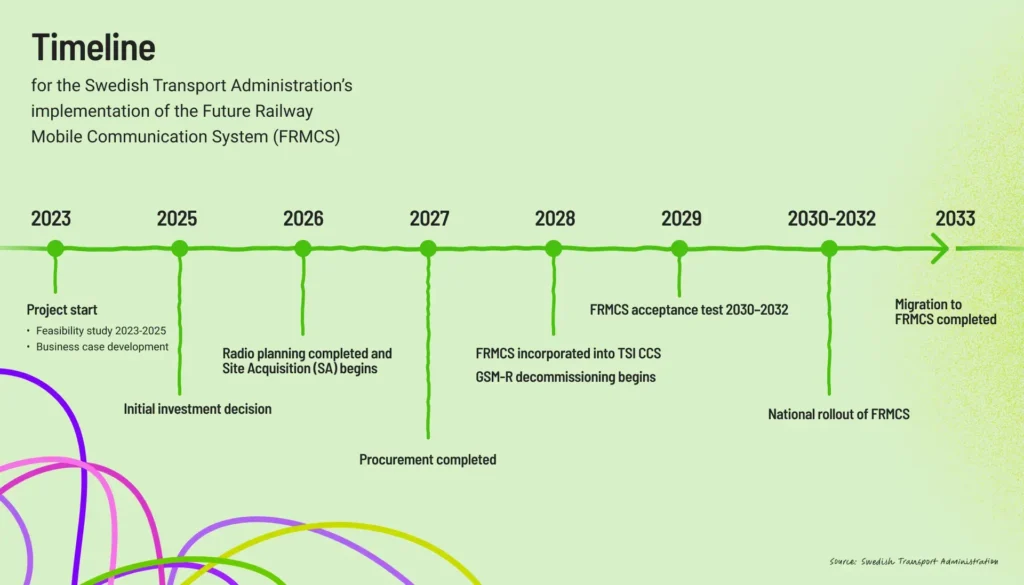
The transition will not be rushed – nor should it be. A system of this scale must be implemented with precision.
“We are talking about a system that will realise operational communication for decades. It cannot be wrong from the start. That is why we spend so much time understanding the whole picture before moving into full rollout,” says Pipsa.
In Sweden, current work focuses on three areas:
1. Deepening testing – both technically and operationally.
2. Establishing common working methods across the sector.
3. Continuing active participation in European cooperation forums where requirements are confirmed through testing, validation, transparency and consensus.
Only once these elements are stabilised can implementation begin to scale.
Technology, safety and societal value – why this transition matters
At its core, FRMCS is a technical platform. But its significance extends far beyond the radio system itself.
A robust communication system is a prerequisite for:
- safer rail operations
- increased capacity utilisation of infrastructure
- energy-efficient driving
- improved information during disruptions
- cross-border traffic that works in practice
- long-term modernisation of the railway.
Digitalisation of the railway is one of the key building blocks for strengthening both European and Swedish competitiveness. FRMCS is the foundation on which these services depend.
“It is easy to think of the communication system as something peripheral. But it affects everything – safety, capacity, maintenance and passengers’ experience of railway accessibility. That is why it is so important that we get this right,” says Pipsa Hallner.
Replacing GSM-R is therefore not only a technical task. It is a way of future-proofing a piece of critical societal infrastructure and creating the conditions for a railway capable of meeting future demands.
Want to help shape the future of digital communication?
Get involved in standardisation – work carried out by people who together develop new technical solutions for society.
Learn more about ITS membership.
Further reading on FRMCS development:
All published Phase 1 technical specifications (2025/2026)
Interview with Sam Berggren, Swedish Transport Administration (2024)