We sign contracts digitally, identify ourselves online and rely on electronic services that vouch for who did what, and when. Usually without giving much thought to why we can actually trust them.
Behind many such services lies the same basic question: can the organisation delivering the service be trusted?
That is the question ETSI EN 319 401 sets out to answer. The standard is one of ETSI’s most downloaded, and it sets common requirements for organisations that provide trust services, such as electronic signatures, electronic seals and electronic time stamps.
In this portrait, we get to know the standard through Paloma Llaneza González, who is rapporteur and editor of the standard at ETSI ESI.
Meet EN 319 401
| Full name | ETSI EN 319 401, General Policy Requirements for Trust Service Providers |
| Home | ETSI ESI (Electronic Signatures and Trust Infrastructures) |
| Current version | V3.2.1, January 2026 |
| First version | January 2013 |
| Predecessors | TS 101 456 and TS 102 042 |
| Strengths | Reliable. Methodical. Risk-aware. Prepared. Sees the big picture. |
| Weaknesses | Demanding. Cautious. Often misunderstood. Sometimes leaves plenty of room for interpretation. |
| Conflict | The same requirements should create comparable security for everyone, yet some can be adapted to an organisation’s actual risks. |
| Struggle | Keeping the common foundation relevant as threats, technology and regulation change. |
| Triggers | New trust services, such as the European Digital Identity Wallet, and a society that depends more and more on our ability to trust one another online. |
| Mission | Turning trust into concrete requirements, putting them to work in day-to-day operations and assessing whether they are met. |
| Motto | “Trust is a behaviour, not a function.” |
Trust is a matter of behaviour
Think about the apps where your whole life lives: your messages, your photos, your profile, the account that proves you are you. You trust whoever runs them with things you would not hand to a stranger. Plenty of companies can store your data. What matters, Paloma explains, is whether they behave properly while they hold it. Do they keep it safe? Do they let only the right people near it? Do they have a plan for the day something breaks or someone tries to break in? Do they own up when they get it wrong?
Paloma describes EN 319 401 as the requirements for good behaviour that we expect from the companies we entrust with our most sensitive information. The focus is less on what they can do and more on whether they can be trusted to do it well. The standard covers, among other things, risk management, access control, cryptographic controls, physical security, network security, incident handling, business continuity and supply chain security.
EN 319 401 in everyday life
It is 7.42 on a Tuesday morning in Stockholm. On a station platform, a woman opens her new employment contract on her phone.
She reads the last few lines and decides to sign.
Behind the screen, a lot is going on. Her identity is tied to the signature, data is processed, cryptographic functions are applied, and the information needed to verify the signature later is created. Exactly how that works, and which requirements apply to the signing service itself, is not for EN 319 401 to say. Other, service-specific standards cover that.
While she waits for her train, EN 319 401 sets the bar high for the organisation behind the service. It is expected to assess its risks, limit access to authorised people, protect its cryptographic keys and devices throughout their life cycle and monitor its systems for anything unusual. There should also be procedures for security incidents, and a plan for keeping operations running through a serious disruption.
The train pulls in. She puts her phone away and wonders what the new job will be like. Whether the signature will hold up never crosses her mind.
A common standard for many services
Trust services do very different jobs, but they all answer the same basic need: we have to be able to trust them.
Electronic signatures are familiar to many. But trust services also include electronic seals, which a legal person, such as a company or a public authority, uses to confirm the origin and integrity of information. An electronic time stamp, in turn, ties data to a specific moment and can show that the information existed at that point.
The services differ, but much of what makes them trustworthy is the same.
EN 319 401 is a horizontal standard: it applies across all types of trust services and gathers their common requirements in one place. Companies implement them once, and conformity assessment bodies assess the result against a single reference.
The vertical, service-specific standards then build on it and add the requirements that apply to a particular service, such as issuing certificates or time stamping. The most common misunderstanding, Paloma says, is the idea that conforming to EN 319 401 makes a provider qualified under eIDAS the EU regulation for trust services. It does not. EN 319 401 is necessary, never sufficient.
Without that horizontal layer, every service would reinvent its own baseline, and conformity across Europe would stop being comparable. According to Paloma, EN 319 401 is the floor on which legal certainty rests: the certainty that lets a contract signed in Madrid hold up in every other EU country. The title, General Policy Requirements for Trust Service Providers, reads as generic. In her words, a standard like this is in fact the precondition for an entire cross-border digital economy.
A foundation that carries more and more
When EN 319 401 was published in 2013, electronic signatures were right there in the title. The introduction talked about e-commerce, cryptographic mechanisms and companies offering services that support electronic signatures. At the same time, the idea that still defines the standard was already there: common requirements for how companies that provide trust services run and manage their operations, whatever service they offer. The first version also built on earlier ETSI requirements for certificate issuers.
A lot has changed since then. eIDAS2, the revised eIDAS Regulation, introduces the European Digital Identity Wallet: a digital tool that people across the EU can use to prove who they are, store and share attestations, and sign documents electronically.
Together with a wider range of trust services, the wallet means that more will rest on the standard. At the same time, cybersecurity has moved up the agenda. In 2024, the standard went through a major revision for NIS2, the EU directive on cybersecurity. The 2026 version goes a step further, aligning the standard with Commission Implementing Regulation (EU) 2024/2690, which lays down technical and methodological requirements for applying the directive.
Paloma sums it up as outward and upward. The horizontal standard becomes more load-bearing as the catalogue of services above it grows.
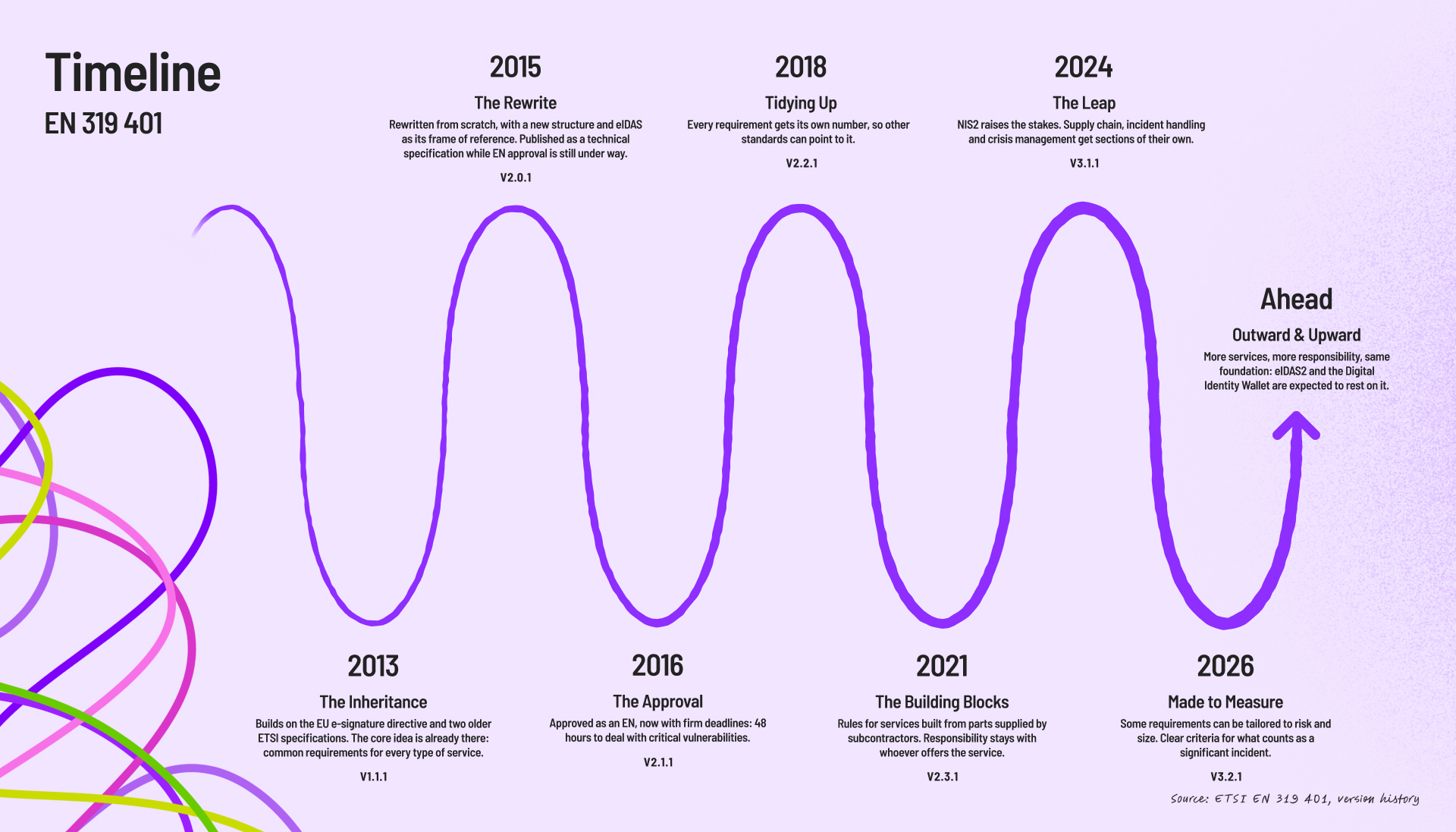
Tidslinjen bygger på versionshistorik för ETSI EN 319 401, General Policy Requirements for Trust Service Providers. Illustration: ITS.
Who uses the standard?
Today, three groups use EN 319 401: the companies that implement it, the conformity assessment bodies that use it as audit criteria, and the supervisory and accreditation bodies that rely on it. The rest of us benefit without ever reading it. The number of users is about to grow. With eIDAS2 and the European Digital Identity Wallet, two new groups come into scope: wallet providers, and issuers of electronic attestations of attributes, such as proof of education or professional entitlement.
The Enabler: Paloma Llaneza González

Paloma Llaneza González, rapportör för ETSI EN 319 401
It is fitting that a lawyer is rapporteur and editor of EN 319 401. Paloma studied programming alongside law, and has spent her whole career moving between two languages that rarely share a room. Since 2004, she has worked at the intersection of law and digital identity.
Her 22 years in standardisation began with information security. She started out as an editor in the ISO/IEC 27000 family, and she was also convenor of a working group in the Spanish national committee. That background matters, she says. At its core, EN 319 401 is information security management applied to trust service providers, so she was already fluent in the discipline underneath. The standard itself refers to ISO/IEC 27002 for guidance.
She is based in Madrid and active in ETSI ESI. She works as Digital Trust Scheme Manager at CerteIDAS, a conformity assessment body that audits qualified trust service providers and is accredited by ENAC, Spain’s national accreditation body. That means she sees both sides at once: the clause as it is written, and the clause as it survives contact with a real audit.
Where the requirements take shape
Technology moves faster than any legislative cycle, and in that gap Paloma sees the strength of standardisation. A regulation says “ensure an appropriate level of security”; the standard is where that sentence turns into requirements with consequences. In the eIDAS model, a published regulation sets the principles and a body of standards gives them concrete, revisable form. That division of labour is, in her view, where the regulation of technology should be heading.
The wording of a single clause can shape what thousands of companies build and what millions of people come to rely on, mostly without knowing the document exists.
She calls it quiet leverage. It rewards precision over noise.
The way into standardisation
To young people thinking about getting involved, she says she would rather be honest than romantic. Standardisation is slow, consensual and unglamorous. Yet this is where the requirements are written. Anyone taking part sits at the table where the wording is decided.
The work rewards people who read carefully, argue precisely and can hold a position through a long negotiation. It is not reserved for engineers. She came in from law with a programming background, and the field needs exactly that kind of crossover: people who understand both the requirement and how it will actually be deployed and audited.
The ways in are concrete: a national committee, a working group, an internship, a first comment on a draft.
– Show up with one good observation and you are already part of it, Paloma says.
Want to help write the requirements rather than just follow them?
Read about what ITS membership involves or book Bettina Funk, ITS CEO, for a company visit where she talks about standardisation (the booking page is in Swedish only.)